By Gerald McConway
Also called removable, acrylic partial dentures, flipper dentures are temporary appliances for filling in gaps in a patient's smile. Consisting of a retainer holding any number of prosthetic teeth, flipper dentures are typically used for replacing front teeth. So, for those who have gaps in their smile and want that fixed as soon as possible, check with your dental professional to see if flipper dentures are the right option for you and your oral health.
Getting Dentures
Whether it's due to tooth decay or injury, losing front teeth can leave patients feeling self-conscious, even to the point of hiding their mouth at any given moment, but this style of dentures can fill those gaps immediately. To create these dentures, a dentist must first make an impression of the patient's mouth, which a dental lab will use to make the actual final product.
Regarding cost, this can vary due to certain factors, such as how many teeth are being replaced, a patient's location, and the materials a dentist uses, costing anywhere from $300 and $500. A patient's dentist can let them know beforehand how much they should anticipate paying, but this choice is often the least expensive type of temporary dentures available.
What Patients Should Expect
When patients first get their flipper denture, it might feel awkward or bulky inside the mouth, but most get used to the new appliance in time. At the same time, patients should keep their dentist informed if there is any pressure or pain caused by their dentures. Both pressure and pain aren't things to get used to-it's a sign the dentures don't fit properly and need adjusting.
Also, because flipper dentures are retainers, one can be flipped out of place by the tongue, so patients should avoid using their tongue to keep their dentures in place. They're also susceptible to staining, so it's best to avoid pigmented drinks and foods, such as curries, dark juice, and coffee, to keep the appliance looking good.
For maintenance, they must be cleaned each day to remove food debris and plaque, using a soft-bristle toothbrush but no toothpaste, which may be too rough on dentures. Instead, use mild soap or a dishwashing liquid before thoroughly rinsing the dentures and putting them back in the mouth.
Moving Forward
Oftentimes, these dentures are meant to be temporary, so that, once a wound has fully healed, a more permanent solution, such as a fixed bridge or dental implants, can be used.
As well, give they can be loose fitting and uncomfortable, they aren't a great long-term solution for most patients. At the same time, they offer a viable, permanent teeth replacement solution for some cases, such as when patients aren't good candidates for fixed bridges or dental implants or if patients have budget limitations.
Article Source: http://EzineArticles.com/9797199

Custom Search
Virginia Tech — and ESPN — turn focus to Saturday night matchup with Clemson
By MIKE BARBER Richmond Times-Dispatch
 BLACKSBURG — All week, Virginia Tech’s football coaches harped on it. Don’t look ahead to Clemson. Focus on Old Dominion.
Moments after the Hokies’ 38-0 win over ODU on Saturday, the players considered that restriction lifted.
“Now we can finally talk about it,” junior defensive tackle Ricky Walker said. “Now it’s on to the next week and the national champions are coming to Lane, Blacksburg. It’s time to go to work.”
No. 2 Clemson (4-0), the reigning national champion, makes its first appearance at Lane Stadium since 2011 for this rematch of the ACC title game. ESPN’s “College GameDay” pregame show returns to Blacksburg for the first time since 2007.
As was expected — presuming both teams won their games that day — the network announced Saturday night that its popular morning show would do its 9 a.m. broadcast featuring Rece Davis, Kirk Herbstreit, Lee Corso and Desmond Howard from Tech’s campus for the first time since the 2007 season opener against East Carolina.
That was the Hokies’ first game following the mass shooting on campus the previous April. In all, ESPN has brought “College GameDay” to Blacksburg five times and the Hokies are 4-1 in those games.
This will be the first appearance for “College GameDay” in Virginia since it visited Harrisonburg in 2015 to broadcast from James Madison, before the Dukes’ 59-49 loss to Richmond, a rare FCS appearance by the ESPN bunch.
Of course, the pregame show is just the sideshow. The main event matches two teams that squared off in Orlando, Fla., in last year’s ACC championship game, which Clemson won 42-35. The Tigers went on to the College Football Playoff, beating Ohio State and then Alabama to win the national title.
“Last year was a tough one, so we have it in the back our head every day,” Walker said.
Clemson, which beat Boston College 34-7 on Saturday, lost quarterback Deshaun Watson, running back Wayne Gallman and wide receivers Mike Williams and Artavis Scott from last year’s championship squad.
Still, the Tigers are undefeated and have a pair of wins over ranked opponents — Auburn and Louisville — already to their credit this year.
Junior Kelly Bryant has taken over at quarterback, Travis Etienne is starring at running back and Deon Cain and Ray-Ray McCloud give the Tigers big-play potential at receiver. Clemson is averaging 37.8 points per game.
Read more >>> http://www.richmond.com/sports/college/acc/virginia-tech-and-espn-turn-focus-to-saturday-night-matchup/article_0a7721c8-5f98-5d37-9547-bdb2efd51083.html
 BLACKSBURG — All week, Virginia Tech’s football coaches harped on it. Don’t look ahead to Clemson. Focus on Old Dominion.
Moments after the Hokies’ 38-0 win over ODU on Saturday, the players considered that restriction lifted.
“Now we can finally talk about it,” junior defensive tackle Ricky Walker said. “Now it’s on to the next week and the national champions are coming to Lane, Blacksburg. It’s time to go to work.”
No. 2 Clemson (4-0), the reigning national champion, makes its first appearance at Lane Stadium since 2011 for this rematch of the ACC title game. ESPN’s “College GameDay” pregame show returns to Blacksburg for the first time since 2007.
As was expected — presuming both teams won their games that day — the network announced Saturday night that its popular morning show would do its 9 a.m. broadcast featuring Rece Davis, Kirk Herbstreit, Lee Corso and Desmond Howard from Tech’s campus for the first time since the 2007 season opener against East Carolina.
That was the Hokies’ first game following the mass shooting on campus the previous April. In all, ESPN has brought “College GameDay” to Blacksburg five times and the Hokies are 4-1 in those games.
This will be the first appearance for “College GameDay” in Virginia since it visited Harrisonburg in 2015 to broadcast from James Madison, before the Dukes’ 59-49 loss to Richmond, a rare FCS appearance by the ESPN bunch.
Of course, the pregame show is just the sideshow. The main event matches two teams that squared off in Orlando, Fla., in last year’s ACC championship game, which Clemson won 42-35. The Tigers went on to the College Football Playoff, beating Ohio State and then Alabama to win the national title.
“Last year was a tough one, so we have it in the back our head every day,” Walker said.
Clemson, which beat Boston College 34-7 on Saturday, lost quarterback Deshaun Watson, running back Wayne Gallman and wide receivers Mike Williams and Artavis Scott from last year’s championship squad.
Still, the Tigers are undefeated and have a pair of wins over ranked opponents — Auburn and Louisville — already to their credit this year.
Junior Kelly Bryant has taken over at quarterback, Travis Etienne is starring at running back and Deon Cain and Ray-Ray McCloud give the Tigers big-play potential at receiver. Clemson is averaging 37.8 points per game.
Read more >>> http://www.richmond.com/sports/college/acc/virginia-tech-and-espn-turn-focus-to-saturday-night-matchup/article_0a7721c8-5f98-5d37-9547-bdb2efd51083.html
Dwyane Wade, Chicago Bulls agree on Contract buyout
 The Cleveland Cavaliers have emerged as clear favorites to land newly minted free agent Dwyane Wade, after he agreed to a buyout agreement with the Chicago Bulls on Sunday, sources told ESPN.com.
Wade agreed to leave about $8 million of his $23.8 million salary on the table after talks between the two sides about a resolution intensified ahead of Monday's start of training camp.
Wade has a long-standing relationship with LeBron James, who attempted to recruit Wade to Cleveland last summer, but the Cavs didn't have salary-cap space at the time. James and Wade have kept in touch this summer about Wade's options, sources said.
In addition to the Cavs, the San Antonio Spurs, Miami Heat and Oklahoma City Thunder are contenders for Wade once his buyout becomes official, sources said. Wade also has a close relationship with Carmelo Anthony, who will officially become a member of the Thunder on Monday.
Wade, speaking to the AP on Sunday night, indicated that he might decide his next move quickly.
"I'm going to take tonight and some of tomorrow and speak to the teams or players that are on my list and go from there,'' Wade said. "My decision is a pure basketball decision, and I'll make the one that fits me best at this point in my career and with what I feel I have to offer a team that needs what I have to offer.''
He also tweeted his thanks to Chicago and its fans.
Last week, Heat president Pat Riley hinted at the team's desire to bring Wade back: "Anything that happens from a personnel standpoint down the road or any opportunities that are there, we're always going to approach that," Riley said about Wade.
Among Wade's expected suitors, the Heat currently would have the most money available to offer, at $4.2 million. The Spurs have $3.3 million, and the Cavs have $2.5 million. The Thunder could offer only the minimum salary, which is $2.3 million. It would be most costly for the Cavs, as they would pay $10.5 million in luxury tax if they added Wade.
The Bulls were motivated to work out a deal with Wade as they begin a rebuilding phase. The team signaled a shift by trading away Jimmy Butler in June and then electing not to re-sign Rajon Rondo.
Chicago had reason to still give Wade roughly $15 million of his salary for the season, as they are still below the mandated salary floor. Earlier Sunday, the team agreed to a new contract with free agent Nikola Mirotic.
Wade averaged 18.3 points, 4.5 rebounds and 3.8 assists in 60 games last season.
Read more >>> http://www.espn.com/nba/story/_/id/20809443/dwyane-wade-chicago-bulls-agree-contract-buyout
PRRD suggests using CHR budget to Buy Body Cameras for cops
President Rodrigo Roa Duterte leads the Oath-taking of the Promoted Star Rank Officers of PNP and Joint AFP-PNP Command Conference. KING RODRIGUEZ/PRESIDENTIAL PHOTO
MANILA, Philippines — The Office of the President and the Department of Budget and Management has proposed over P600 million for the 2018 budget of the Commission on Human Rights (CHR).
 Although, only P1,000 has been agree with by the House of Representatives.
President Rodrigo Duterte said, if Congress will not give the proposed budget to CHR, it might as well use the fund to buy modern equipment such as body cameras for members of the Philippine National Police (PNP).
“Kung ayaw ninyong isauli ‘yung pera diyan sa CHR (If you don’t want to return the budget to CHR), why don’t you invest the money to buy equipment for the police,” he said.
Duterte added that P600 million is sufficient to buy state-of-the-art cameras the size of a button that all policemen can wear 24 hours a day.
The President said such types of equipment can help greatly in the administration’s war on drugs as long as it doesn’t violate the privacy of law enforcers.
“Just don’t invade the privacy of the soldiers and the policemen. But you are free to implant and place cameras on the body of the law enforcers whenever they go out to operate because the Philippines is a narco-state already,” he said.
Read more >>> https://ph.yahoo.com/news/prrd-suggests-using-chr-budget-042324182.html
MANILA, Philippines — The Office of the President and the Department of Budget and Management has proposed over P600 million for the 2018 budget of the Commission on Human Rights (CHR).
 Although, only P1,000 has been agree with by the House of Representatives.
President Rodrigo Duterte said, if Congress will not give the proposed budget to CHR, it might as well use the fund to buy modern equipment such as body cameras for members of the Philippine National Police (PNP).
“Kung ayaw ninyong isauli ‘yung pera diyan sa CHR (If you don’t want to return the budget to CHR), why don’t you invest the money to buy equipment for the police,” he said.
Duterte added that P600 million is sufficient to buy state-of-the-art cameras the size of a button that all policemen can wear 24 hours a day.
The President said such types of equipment can help greatly in the administration’s war on drugs as long as it doesn’t violate the privacy of law enforcers.
“Just don’t invade the privacy of the soldiers and the policemen. But you are free to implant and place cameras on the body of the law enforcers whenever they go out to operate because the Philippines is a narco-state already,” he said.
Read more >>> https://ph.yahoo.com/news/prrd-suggests-using-chr-budget-042324182.html
John Pinette Dead: Comedian And 'Seinfeld' Actor Dies At 50

John Pinette was found dead on April 6. The comedian was discovered in his Pittsburgh hotel room around 2:30 p.m., according to the Allegheny County medical examiner's office.
TMZ reports that Pinette was suffering from liver and heart disease. Though no autopsy has been performed, his manager, Larry Schapiro, told the Hollywood Reporter that Pinette died from a pulmonary embolism.
In August of 2013, Pinette cancelled a standup routine and checked into rehab for prescription pill addiction. He was currently on tour from April to June, with set dates scheduled through the U.S. and Canada.
Pinette's resume includes films such as "The Punisher" (2004) and "The Last Godfather" (2010). He is best known for his 1998 role in "Seinfeld," as the man who was mugged in the final episode of the show.
Source: http://www.huffingtonpost.com/2014/04/06/john-pinette-dead_n_5101932.html
Hollywood legend Mickey Rooney dies
Donna Freydkin, USA TODAY
Mickey Rooney was the original Hardy boy. His 200-plus film credits notwithstanding, the spry, spirited Rooney will be best remembered for playing the impetuous title character in MGM's beloved Andy Hardy movies.
Rooney, 93, who died Sunday surrounded by family at his North Hollywood home, leaves behind a colorful Hollywood legacy that spanned 80 years and a couple hundred films, including Boys Town and The Black Stallion.
REACTION: Celebrities grieve, salute on Twitter
He won two honorary Oscars, the first in 1938, the second in 1982. In January 2005, Rooney made headlines for the unlikeliest of reasons when Fox rejected a Super Bowl cold remedy commercial — featuring Rooney's bared bottom — for being inappropriate.
Rooney certainly knew how to put on a show. But of all the characters that Rooney inhabited — from Puck in the 1935 film production of A Midsummer Night's Dream to his Oscar-nominated turn as a preternaturally mature teen in 1943's The Human Comedy — not one could compete with or begin to overshadow Rooney himself.
Laurence Olivier called Rooney "the greatest actor of them all," yet he was the unlikeliest of stars. At 5-foot-3, Rooney was short, with pointy, elfin features and a spirited, in-your-face energy more suited to selling cars than starring in films. Yet during the Depression, when jobs were scarce and the national mood grim, audiences loved his joie de vivre and his down-home appeal.
Born Joe Yule, Jr. in a Brooklyn, N.Y., rooming house on Sept. 23, 1920, Rooney made his first stage appearance at 17 months as part of his comic father and dancer mother's vaudeville performances. Performing, Rooney told BackStage, was "in my blood. It's who I am."
He switched to the silver screen at age 6, playing the title character Mickey McGuire in 78 film shorts based on the old Toonerville Trolley cartoons from 1927 until 1933. In 1932, he changed his moniker to the catchier Mickey Rooney, and five years later landed the role that would define him for the rest of his career: the feisty teen-about-town Andy Hardy, with a cheeky grin, irresistible boy-next-door charm and plenty of romantic mishaps.
The 15-part movie series was such a smash that from 1939 to 1941, Rooney became the Tom Cruise of his time: the No. 1 box-office draw in the country.
But like any good mutual fund, Rooney diversified, playing a problem child in Boys Town opposite Spencer Tracy in 1938 and co-starring in the 1939 musical Babes in Arms with longtime collaborator and pal Judy Garland, with whom he co-starred in 10 films. The two enjoyed a close friendship off-screen and it was no coincidence that of all his Hollywood compatriots, Rooney bonded most with Garland, a troubled star who, like him, matured in front of the cameras and struggled to find her footing as an adult.
At the peak of his fame, Rooney met President Roosevelt in the White House and auto magnate Henry Ford in Dearborn, Mich. And soon, his personal life became every bit as gaudy as his film roles, starting with his 1942 marriage to sultry actress Ava Gardner, the first of his eight wives (they split in 1943).
His popularity soaring, his star ever rising, Rooney's success seemed unstoppable — until 1944, when he served in World War II, joining the entertainment brigade dubbed the Jeep Theater and traveling 150,000 miles to entertain more than 2 million overseas troops.
But when the war was over in 1945 and Rooney returned to Hollywood, he was suddenly something of an outsider. MGM, the studio that had turned Rooney into a megastar, dropped him. And he found there was little industry wiggle room for a quirky, unconventionally appealing actor who wasn't a kid anymore, but lacked the stature of a mature leading man.
Like Macaulay Culkin in the 1990s, Rooney had trouble making the transition from kid star to adult actor.
But Rooney, ever the realist, knew his time at the top would be short-lived. "I tell you, there are 150 million kids waiting to fill the reservoir," he told USA TODAY in 1994. "I say bravo to the youngsters. I had my day at bat."
So the impish, scampy star reinvented himself as a character actor, with solid if supporting turns in 1954's The Bridges at Toko-Ri and 1956's The Bold and the Brave.
But by the 1960s, Rooney told the London Times in 1988, "the work was very sparse indeed: there was just no demand for me."
Well, not quite. Rooney kept right on acting, playing a horse trainer in 1979's The Black Stallion and returning to the stage and dazzling audiences in the 1979 Broadway spectacle Sugar Babies, which earned him a Tony nomination. Rooney "is the heart, soul and body of the enterprise," raved Newsweek.
"I was a very famous has-been until this show," Rooney told the Associated Press in 1979. "Now, it's almost like the resurrection of a career, of someone saying, 'He didn't cop out on us, he's still there.' "
Indeed, he was there all along, plugging away. But his long list of screen credits aside, Rooney will also be remembered for his marrying ways. Just call Rooney, who said "I do" eight times, the male Elizabeth Taylor.
But Rooney was dismissive of all the fascination with his bedroom antics and insisted that he wasn't addicted to walking down the aisle.
"I was selective," Rooney told People in 1993. "I was looking for a woman who knew how to be a woman ... who knew how a man needs to be treated."
He looked long and hard, trying his luck with, among others, model Elaine Mahnken, California beauty Barbara Ann Thomason and secretary Carolyn Hockett before ending up with country singer/songwriter Jan Chamberlin in 1978. "I guess I practiced a lot," Rooney told New York Daily News in 2004. "But you've got to remember, this is the one that counts."
And to him, all those trips to the altar weren't too big a deal.
"Isn't it a funny thing that Cary Grant, who was a dear friend of mine, married five times, but they don't say anything about that?" Rooney mused to People in 1991. "It's like my divorces were dastardly deeds. I was supposed to marry my high school sweetheart and go off into the sunset with a box of detergent."
You might have spotted him as the speechless Fugly Floom in the sweet 1998 smash Babe: Pig in the City. Or heard him voice a junkyard dog in 2001's Lady and the Tramp II: Scamp's Adventure. But despite his work ethic, Rooney filed for bankruptcy in 1996 with more than $1 million in debts.
Rooney spent his twilight years with wife Jan in a posh Los Angeles home filled with family pictures. He wrote. He painted. And he remained true to his religion after joining the Church of Religious Science in the 1960s. "We all leave the church some time," he told the AP in 1979. "All of a sudden, your life is empty. I went back because I realized God had never left me. I left Him."
And he kept right on performing, going on the road with his wife in the biographical revue Let's Put on a Show, a touching, intimate traveling tour down memory lane.
"I don't retire, I inspire," Rooney told the Palm Beach Post in 2001. "Mickey Rooney is not great. Mickey Rooney was fortunate to have been an infinitesimal part of motion pictures and show business."
Source: http://www.usatoday.com/story/life/people/2014/04/06/mickey-rooney-dies/7404557/
Mickey Rooney was the original Hardy boy. His 200-plus film credits notwithstanding, the spry, spirited Rooney will be best remembered for playing the impetuous title character in MGM's beloved Andy Hardy movies.
Rooney, 93, who died Sunday surrounded by family at his North Hollywood home, leaves behind a colorful Hollywood legacy that spanned 80 years and a couple hundred films, including Boys Town and The Black Stallion.
REACTION: Celebrities grieve, salute on Twitter
He won two honorary Oscars, the first in 1938, the second in 1982. In January 2005, Rooney made headlines for the unlikeliest of reasons when Fox rejected a Super Bowl cold remedy commercial — featuring Rooney's bared bottom — for being inappropriate.
Rooney certainly knew how to put on a show. But of all the characters that Rooney inhabited — from Puck in the 1935 film production of A Midsummer Night's Dream to his Oscar-nominated turn as a preternaturally mature teen in 1943's The Human Comedy — not one could compete with or begin to overshadow Rooney himself.
Laurence Olivier called Rooney "the greatest actor of them all," yet he was the unlikeliest of stars. At 5-foot-3, Rooney was short, with pointy, elfin features and a spirited, in-your-face energy more suited to selling cars than starring in films. Yet during the Depression, when jobs were scarce and the national mood grim, audiences loved his joie de vivre and his down-home appeal.
Born Joe Yule, Jr. in a Brooklyn, N.Y., rooming house on Sept. 23, 1920, Rooney made his first stage appearance at 17 months as part of his comic father and dancer mother's vaudeville performances. Performing, Rooney told BackStage, was "in my blood. It's who I am."
He switched to the silver screen at age 6, playing the title character Mickey McGuire in 78 film shorts based on the old Toonerville Trolley cartoons from 1927 until 1933. In 1932, he changed his moniker to the catchier Mickey Rooney, and five years later landed the role that would define him for the rest of his career: the feisty teen-about-town Andy Hardy, with a cheeky grin, irresistible boy-next-door charm and plenty of romantic mishaps.
The 15-part movie series was such a smash that from 1939 to 1941, Rooney became the Tom Cruise of his time: the No. 1 box-office draw in the country.
But like any good mutual fund, Rooney diversified, playing a problem child in Boys Town opposite Spencer Tracy in 1938 and co-starring in the 1939 musical Babes in Arms with longtime collaborator and pal Judy Garland, with whom he co-starred in 10 films. The two enjoyed a close friendship off-screen and it was no coincidence that of all his Hollywood compatriots, Rooney bonded most with Garland, a troubled star who, like him, matured in front of the cameras and struggled to find her footing as an adult.
At the peak of his fame, Rooney met President Roosevelt in the White House and auto magnate Henry Ford in Dearborn, Mich. And soon, his personal life became every bit as gaudy as his film roles, starting with his 1942 marriage to sultry actress Ava Gardner, the first of his eight wives (they split in 1943).
His popularity soaring, his star ever rising, Rooney's success seemed unstoppable — until 1944, when he served in World War II, joining the entertainment brigade dubbed the Jeep Theater and traveling 150,000 miles to entertain more than 2 million overseas troops.
But when the war was over in 1945 and Rooney returned to Hollywood, he was suddenly something of an outsider. MGM, the studio that had turned Rooney into a megastar, dropped him. And he found there was little industry wiggle room for a quirky, unconventionally appealing actor who wasn't a kid anymore, but lacked the stature of a mature leading man.
Like Macaulay Culkin in the 1990s, Rooney had trouble making the transition from kid star to adult actor.
But Rooney, ever the realist, knew his time at the top would be short-lived. "I tell you, there are 150 million kids waiting to fill the reservoir," he told USA TODAY in 1994. "I say bravo to the youngsters. I had my day at bat."
So the impish, scampy star reinvented himself as a character actor, with solid if supporting turns in 1954's The Bridges at Toko-Ri and 1956's The Bold and the Brave.
But by the 1960s, Rooney told the London Times in 1988, "the work was very sparse indeed: there was just no demand for me."
Well, not quite. Rooney kept right on acting, playing a horse trainer in 1979's The Black Stallion and returning to the stage and dazzling audiences in the 1979 Broadway spectacle Sugar Babies, which earned him a Tony nomination. Rooney "is the heart, soul and body of the enterprise," raved Newsweek.
"I was a very famous has-been until this show," Rooney told the Associated Press in 1979. "Now, it's almost like the resurrection of a career, of someone saying, 'He didn't cop out on us, he's still there.' "
Indeed, he was there all along, plugging away. But his long list of screen credits aside, Rooney will also be remembered for his marrying ways. Just call Rooney, who said "I do" eight times, the male Elizabeth Taylor.
But Rooney was dismissive of all the fascination with his bedroom antics and insisted that he wasn't addicted to walking down the aisle.
"I was selective," Rooney told People in 1993. "I was looking for a woman who knew how to be a woman ... who knew how a man needs to be treated."
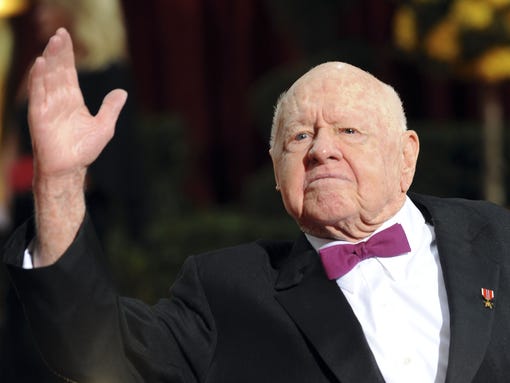 |
| Mickey Rooney arrives at the 81st Annual Academy Awards held at The Kodak Theatre on February 22, 2009 in Hollywood, Calif.(Photo: Jeff Kravitz, FilmMagic) |
And to him, all those trips to the altar weren't too big a deal.
"Isn't it a funny thing that Cary Grant, who was a dear friend of mine, married five times, but they don't say anything about that?" Rooney mused to People in 1991. "It's like my divorces were dastardly deeds. I was supposed to marry my high school sweetheart and go off into the sunset with a box of detergent."
You might have spotted him as the speechless Fugly Floom in the sweet 1998 smash Babe: Pig in the City. Or heard him voice a junkyard dog in 2001's Lady and the Tramp II: Scamp's Adventure. But despite his work ethic, Rooney filed for bankruptcy in 1996 with more than $1 million in debts.
Rooney spent his twilight years with wife Jan in a posh Los Angeles home filled with family pictures. He wrote. He painted. And he remained true to his religion after joining the Church of Religious Science in the 1960s. "We all leave the church some time," he told the AP in 1979. "All of a sudden, your life is empty. I went back because I realized God had never left me. I left Him."
And he kept right on performing, going on the road with his wife in the biographical revue Let's Put on a Show, a touching, intimate traveling tour down memory lane.
"I don't retire, I inspire," Rooney told the Palm Beach Post in 2001. "Mickey Rooney is not great. Mickey Rooney was fortunate to have been an infinitesimal part of motion pictures and show business."
Source: http://www.usatoday.com/story/life/people/2014/04/06/mickey-rooney-dies/7404557/
The Perils of Paul Sturgess, the Tallest Basketball Player in the World
STACK
One would think basketball should be easy for Paul Sturgess. At 7-foot-8, Sturgess—the center for the NBA Development League’s Texas Legends—is the tallest professional basketball player in the world. The rim stands less than three feet above his head and is within reach of his long, gangly arms. His opponents, D-League players who would be tall in any other setting, look like jersey-wearing Lilliputians compared to Sturgess.
But great height comes with great challenges, and late into the Legends’ season, Sturgess had appeared in just 12 games, averaging only 0.9 points and 0.9 rebounds per outing. He hadn’t yet registered a block. Sturgess hasn’t seen much court time, because despite his size, his body isn’t yet court-ready in the eyes of many. And as it turns out, developing Sturgess’s body to handle the demands of pro basketball is surprisingly complicated.
For starters, Sturgess is not especially well-conditioned. The 26-year-old left his native England in 2007 to play college ball in the States, and after school he joined the Harlem Globetrotters in 2011. There, he was known for his “No Jump Dunk.” He played in exhibition games for a team focused on entertainment, not competitive development.
“Not to take anything away from Paul’s accomplishments with the Globetrotters, but they didn’t practice, they rehearsed,” said Travis Blakeley, the Legends' director of player personnel and assistant coach. “[The Globetrotters] had zero weight room time, zero performance time.”
Blakeley began working with Sturgess after the tall hipster joined the Legends, in November 2013. On Sturgess's first day of practice, his feet bled through his shoes as he tried to keep up with his teammates running up and down the court. His size 22 dogs weren’t ready for the speed of the professional game. So Blakely tried a different approach, putting Sturgess through workouts on a stationary bike and light shuttle runs, bouts of cardio that placed less stress on his lower extremities than running the court.
“We were taking on an extremely green athlete and had to scale it way back to the basics,” Blakeley added.
After weeks of work, and with some new kicks and tape on his feet, Sturgess was in better shape. But he still needed to develop the strength to handle the pounding of the inside game. Unfortunately, his extreme height, combined with his weight (320 pounds), makes many athlete-development moves like Squats and Lunges risky for him, since they place an undue amount of stress on his knees, hips and lower back. Instead, Blakeley had Sturgess start out with Leg Presses, which develop lower-body strength without subjecting the knees to as much wear and tear.
Another issue preventing Sturgess from seeing significant minutes is the league’s verticality rule, which requires referees to call a foul whenever a player does not jump straight up in the air while defending a shot. Sturgess, like many tall people, tends to slouch. And since he’s been very tall during his entire adult life (he reached the 7-foot mark at age 16), Sturgess has developed a bit of a hunch in his neck, back and shoulders from many years of slouching. This posture makes it almost impossible for him to adhere to the rule, turning what should be his greatest strength (guarding the rim) into a reason for referees to blow the whistle.
“Paul struggles just to bring his hands even to a 90-degree plane at his head and shoulders,” Blakeley said. “He tends to be about 6 inches out in front of his head. While that’s still very high up in the air, it’s an easy indicator for the referee to blow his whistle.”
To combat this, Blakeley has Sturgess perform Shoulder Presses and Shoulder Flies with very low weight to open up his neck and shoulders. He also uses an on-court drill called “Hot Box,” in which Sturgess stands 3 feet from the rim, back to the basket, and attempts to catch basketballs thrown at his body. The balls can be thrown toward his chest or out to his right or left, forcing him to quickly move his hands and body. After catching the ball, he turns around and puts it through the hoop.
“That’s why flexibility in [Paul’s] shoulders and neck is a huge priority for us,” Blakely added. “We need to make it so that when he goes up, he goes straight up without any angle in his arms or in his shoulders to avoid those type of fouls.”
Sturgess struggles the most with what Blakeley calls “dynamic movements"—quick bursts of acceleration and sudden changes of direction. A smaller, more mobile player can throw Sturgess off balance. So Blakeley has him working to improve flexibility in his hips and strengthen his inner abs and core, which should help him keep his balance when he reacts to speedy moves. Sturgess also jumps rope and performs agility drills to improve his reaction time.
“I’ve been (jumping rope) for a couple months now, and I am already feeling the benefits of how much better I move,” Sturgess said. “It helps me jump quicker and more explosively. I also do a lot of agility exercises and lateral slides, which helps me open up my hips and helps me move.”
The work is beginning to pay off, according to both men. Sturgess is making progress in his workouts, and Blakeley is slowly adding strength-building exercises like Squats to the lofty center’s routine. Blakeley’s goal is for Sturgess to reach the point where he can stay on the court for 12 to 14 consecutive trips up and down the floor at the D-League pace, which is significantly faster than the NBA’s—the top four teams average over 110 points per game, including the leading Rio Grande Valley Vipers, who score 123.5 points per game, 16 more than the Los Angeles Clippers, who lead the NBA.
Blakeley also wants Sturgess to get to a point where he feels like a integral part of the team.
“You know the old song, ‘I wish I was a little bit taller, I wish I was a baller’? It’s a great wish, but at Paul’s size, you wish you were a little bit normal,” Blakeley said. “Of course, there are certain times when he gets frustrated. But he’ll take the frustration and turn it around and work that much harder.”
Sturgess has plenty of frustrating days,but he always keeps his mind on the future. He said, "I never compare myself to other people. Whenever I’m doing an exercise, I never think about how well I’m doing now. If I do it every day, I’m going to get better. I always have that in my mind.”
Source: http://sports.yahoo.com/news/perils-paul-sturgess-tallest-basketball-091045991.html
One would think basketball should be easy for Paul Sturgess. At 7-foot-8, Sturgess—the center for the NBA Development League’s Texas Legends—is the tallest professional basketball player in the world. The rim stands less than three feet above his head and is within reach of his long, gangly arms. His opponents, D-League players who would be tall in any other setting, look like jersey-wearing Lilliputians compared to Sturgess.
But great height comes with great challenges, and late into the Legends’ season, Sturgess had appeared in just 12 games, averaging only 0.9 points and 0.9 rebounds per outing. He hadn’t yet registered a block. Sturgess hasn’t seen much court time, because despite his size, his body isn’t yet court-ready in the eyes of many. And as it turns out, developing Sturgess’s body to handle the demands of pro basketball is surprisingly complicated.
For starters, Sturgess is not especially well-conditioned. The 26-year-old left his native England in 2007 to play college ball in the States, and after school he joined the Harlem Globetrotters in 2011. There, he was known for his “No Jump Dunk.” He played in exhibition games for a team focused on entertainment, not competitive development.
“Not to take anything away from Paul’s accomplishments with the Globetrotters, but they didn’t practice, they rehearsed,” said Travis Blakeley, the Legends' director of player personnel and assistant coach. “[The Globetrotters] had zero weight room time, zero performance time.”
Blakeley began working with Sturgess after the tall hipster joined the Legends, in November 2013. On Sturgess's first day of practice, his feet bled through his shoes as he tried to keep up with his teammates running up and down the court. His size 22 dogs weren’t ready for the speed of the professional game. So Blakely tried a different approach, putting Sturgess through workouts on a stationary bike and light shuttle runs, bouts of cardio that placed less stress on his lower extremities than running the court.
“We were taking on an extremely green athlete and had to scale it way back to the basics,” Blakeley added.
After weeks of work, and with some new kicks and tape on his feet, Sturgess was in better shape. But he still needed to develop the strength to handle the pounding of the inside game. Unfortunately, his extreme height, combined with his weight (320 pounds), makes many athlete-development moves like Squats and Lunges risky for him, since they place an undue amount of stress on his knees, hips and lower back. Instead, Blakeley had Sturgess start out with Leg Presses, which develop lower-body strength without subjecting the knees to as much wear and tear.
Another issue preventing Sturgess from seeing significant minutes is the league’s verticality rule, which requires referees to call a foul whenever a player does not jump straight up in the air while defending a shot. Sturgess, like many tall people, tends to slouch. And since he’s been very tall during his entire adult life (he reached the 7-foot mark at age 16), Sturgess has developed a bit of a hunch in his neck, back and shoulders from many years of slouching. This posture makes it almost impossible for him to adhere to the rule, turning what should be his greatest strength (guarding the rim) into a reason for referees to blow the whistle.
“Paul struggles just to bring his hands even to a 90-degree plane at his head and shoulders,” Blakeley said. “He tends to be about 6 inches out in front of his head. While that’s still very high up in the air, it’s an easy indicator for the referee to blow his whistle.”
To combat this, Blakeley has Sturgess perform Shoulder Presses and Shoulder Flies with very low weight to open up his neck and shoulders. He also uses an on-court drill called “Hot Box,” in which Sturgess stands 3 feet from the rim, back to the basket, and attempts to catch basketballs thrown at his body. The balls can be thrown toward his chest or out to his right or left, forcing him to quickly move his hands and body. After catching the ball, he turns around and puts it through the hoop.
“That’s why flexibility in [Paul’s] shoulders and neck is a huge priority for us,” Blakely added. “We need to make it so that when he goes up, he goes straight up without any angle in his arms or in his shoulders to avoid those type of fouls.”
Sturgess struggles the most with what Blakeley calls “dynamic movements"—quick bursts of acceleration and sudden changes of direction. A smaller, more mobile player can throw Sturgess off balance. So Blakeley has him working to improve flexibility in his hips and strengthen his inner abs and core, which should help him keep his balance when he reacts to speedy moves. Sturgess also jumps rope and performs agility drills to improve his reaction time.
“I’ve been (jumping rope) for a couple months now, and I am already feeling the benefits of how much better I move,” Sturgess said. “It helps me jump quicker and more explosively. I also do a lot of agility exercises and lateral slides, which helps me open up my hips and helps me move.”
The work is beginning to pay off, according to both men. Sturgess is making progress in his workouts, and Blakeley is slowly adding strength-building exercises like Squats to the lofty center’s routine. Blakeley’s goal is for Sturgess to reach the point where he can stay on the court for 12 to 14 consecutive trips up and down the floor at the D-League pace, which is significantly faster than the NBA’s—the top four teams average over 110 points per game, including the leading Rio Grande Valley Vipers, who score 123.5 points per game, 16 more than the Los Angeles Clippers, who lead the NBA.
Blakeley also wants Sturgess to get to a point where he feels like a integral part of the team.
“You know the old song, ‘I wish I was a little bit taller, I wish I was a baller’? It’s a great wish, but at Paul’s size, you wish you were a little bit normal,” Blakeley said. “Of course, there are certain times when he gets frustrated. But he’ll take the frustration and turn it around and work that much harder.”
Sturgess has plenty of frustrating days,but he always keeps his mind on the future. He said, "I never compare myself to other people. Whenever I’m doing an exercise, I never think about how well I’m doing now. If I do it every day, I’m going to get better. I always have that in my mind.”
Source: http://sports.yahoo.com/news/perils-paul-sturgess-tallest-basketball-091045991.html
Subscribe to:
Posts (Atom)
More Celebrities and Stories
-
 Many Filipinos here in the Philippines who are very gorgeous voice that made them very popular because of their abilities of singing. The to...
 -
 Famous and top best Singers in the World who been making money because of their talents of singing are figured out. Knowing the top...
 -
Jovit Baldivino Profile IMAGE SOURCE Age: 16 Years Old HomeTown: Batangas School: Padre V. Garcia National High School Batangas ...
-
 IMAGE SOURCE Rodolfo Vera Quizon, Sr ., OGH, (July 25, 1928 – July 10, 2012) known by his screen name Dolphy, was a Filipino comedia...
 -
 The top Filipino female celebrity singers are Pops Fernandez, Regine Velasquez, Sarah Geronimo, Jaya, Vina Morales, Yeng Constantino, Sheryn...
 -
 Francisco Gaudencio Lupe Belardo Mañalac or known as Bamboo a former lead vocalist of Rivermaya bands before who been famous r...
 -
 Paulina Mary Jean Gretzky (born December 19, 1988) at Cedars-Sinai Medical Center four months after Wayne was traded to the Los Angeles K...
 -
 Yes, the words “fake” and “Pamela Anderson” are often used together, but in this instance the fake part has less to do with the surgically...
 -
 Judy Anne Santos History One of the famous best celebrity actress, film producer, products endorser and recording artist Judy Anne Luma...
 -
 Martin Ramon Razon Nievera is one of the best actor, singer and host in the Philippines currently serving the main host on ASAP XV (Abs-Cb...
